How ten leaders have shaped world events
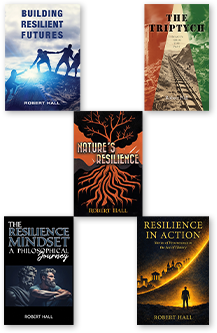
A new book, Resilience in Action: Stories of Perseverance in
the Arc of History, can be obtained from:
https://www.austinmacauley.com/book/resilience-in-action and all good book
sellers. See video at: https://youtu.be/yr71u3w0-Hc
Hope is a central theme of this new book. It compels people to overcome
adversity and reach safety. It also encourages us to reinvent ourselves at time
of crisis, thereby seeking new opportunities and extending our natural
curiosity and inventiveness. Sir John Franklin, a polar explorer, did this when
his traditional naval career came to an end, and he turned to exploration as a
way to remain relevant. In more modern times, Volodymyr Zelensky pursued a
political career following his successful acting days when the opportunity
arose and Ukraine called. To overcome our trials and tribulations, whether
individually or collectively, and bounce forward not back, there must be an
overwhelming desire to persevere in the hope of better things ahead. If hope
springs eternal, it needs resilience to flow in abundance.
The other dominant themes of the book are situational awareness and
perspective. Resilience is about not just knowledge but also seeing the whole
rather than the discrete parts. It is about seeing the interconnections and
inter-relationships that multiply as society and the threats to it grow ever
more sophisticated. Alexander the Great and King Æthelstan were both good at
achieving this perspective and battled with political, military and societal
dynamics to improve their respective nations. Courage was another key attribute
that brought out the greatness of these leaders.
Leaders also play a decisive role in shaping how adversity is interpreted and
adapting to the situation. They frame challenges as tests and opportunities;
they help us see adversity as part of a larger story, not a dead end; and they
provide a narrative that helps transform chaos into coherence. This is exactly
what Marcus Aurelius did during the Roman plague and Marcomannic wars; he
reframed suffering as part of the human condition and a chance to apply virtue.
Adaptive leaders like T E Lawrence thrived in uncertainty and encouraged
experimentation where there were no norms: his empathetic leadership was part
of his resilience.
Some leaders can change styles to suit the prevailing circumstances; Odysseus
excelled at this. Characters like Joan of Arc and Dr Mary Edwards Walker
demonstrated clearly that adaptation and leadership were not a male preserve:
they were as robust and determined as their male compatriots.
Each of the figures described in this book embodies a different mode of
resilience, shaped by their worldview at the time, their trials and the kind of
burden they carried. The array of characters offers valued insights into the
resilience domain and the history behind them as well as providing a
fascinating journey into our rich and resilient past. By comparing and
contrasting the characters in this book, we can see why they were successful as
leaders and stewards of resilience across the ages.
Post Views : 2